

 简体中文
简体中文 English
2025 Global Intelligent Tool Cabinet Market Analysis Report(Reprinted)
2026-04-03
1.1 Policy analysis of the global intelligent tool cabinet industry
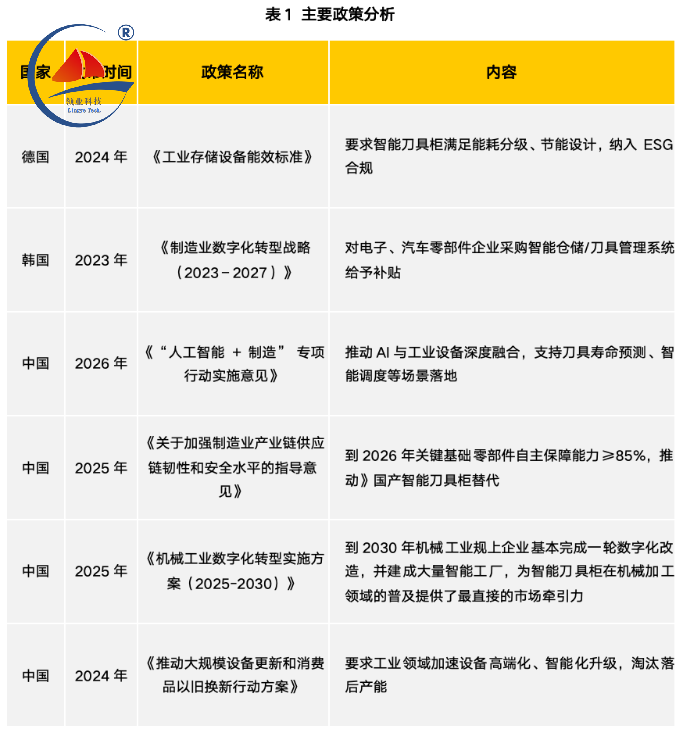
Analysis of the impact of policies on the intelligent tool cabinet market:
Driven by China's digital transformation and subsidies from China and South Korea, the demand for intelligent tool cabinets in the market will rapidly increase;
Global policies mandate the integration of energy efficiency and AI, accelerating the industry's iteration towards high-end products that are "green+intelligent";
Chinese policies strongly support domestic substitution, which will significantly increase the share of local manufacturers and squeeze import space;
The digital transformation and supply chain security strategy provide the industry with a long-term and definite logic for penetration growth.
1.2 Global intelligent tool cabinet new incremental market size and trend
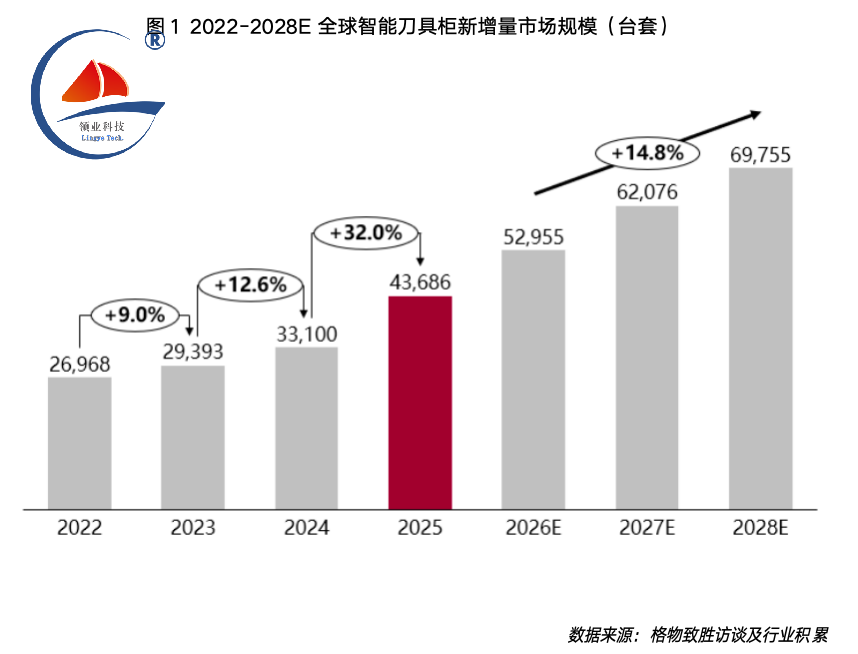
The global intelligent tool cabinet market is expected to grow rapidly in 2025, mainly driven by the upgrading of manufacturing automation. It is expected that the compound annual growth rate will remain at around 15% in the next three years, with the Asian market (especially China) dominating and contributing more than 40% of the global market share, mainly due to the demand for intelligent manufacturing in industries such as automotive and 3C electronics.
As the birthplace of traditional manufacturing and technological innovation worldwide, Europe and America have extremely strict requirements for production accuracy, reliability, and automation levels in industries such as automotive manufacturing, aerospace, semiconductors, and precision machinery. This industry characteristic has given rise to a strong demand for high-precision automated tool management systems, laying a solid foundation for market growth. Among them, the growth momentum of the North American market mainly comes from the continuous driving force of the three major industries of automobiles, aerospace, and semiconductors.Japan and South Korea are the core regions of the global high-end manufacturing industry. With the rapid development of electronic manufacturing and robotics industries, coupled with the upgrading needs of precision machinery, automotive manufacturing, and semiconductor industries, there is a significant demand for intelligent and automated tool management tools. As a key equipment for optimizing tool management, intelligent tool cabinets have become an inevitable choice for their industrial upgrading.
Driven by the global manufacturing transfer dividend, the electronics and auto parts industries in Southeast Asia are experiencing explosive expansion, directly driving the demand for intelligent tool cabinets. At present, although the market is dominated by mid to low end products, with the acceleration of industrial upgrading, the penetration rate of intelligent tool cabinets in top electronic foundries will rapidly penetrate and comprehensively increase, becoming the core focus of future growth.
1.3 Global market size and trend of intelligent tool cabinet inventory
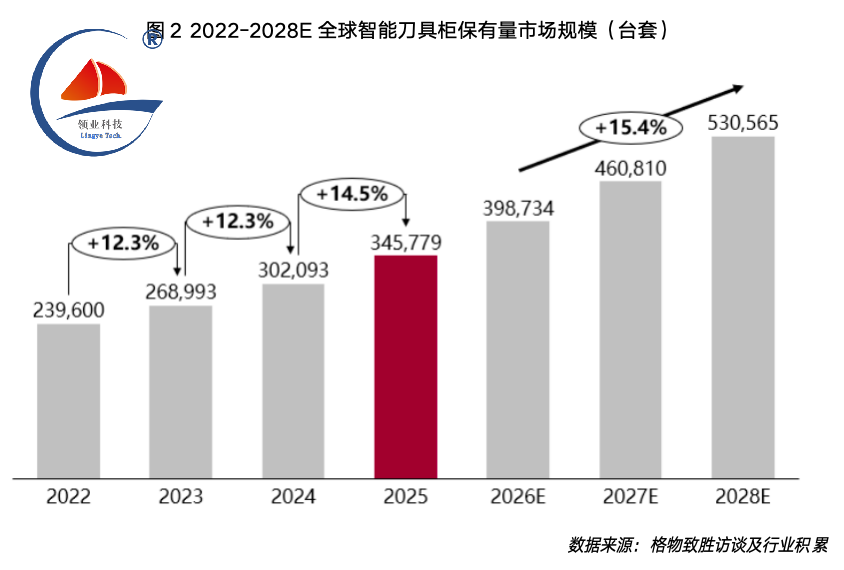
By 2025, the global market for intelligent tool cabinets will have a total inventory of approximately 346000 units, a year-on-year increase of about 14.5%. From a regional distribution perspective, the European and American markets, due to their early development of manufacturing automation and mature technological systems, currently account for 40% -45% of the global market. The products are mainly used in high-end manufacturing industries such as aerospace and medical. The future growth of inventory will rely on the dual drive of technological iteration and environmental policies. The Asian market accounts for about 41% of the total inventory, and China, as the core growth pole in the region, will steadily increase its market share of intelligent tool cabinets driven by technological breakthroughs, industry demand, and policy support. As an emerging market, Southeast Asia currently has a relatively low base of intelligent tool cabinet ownership. However, driven by the transfer of manufacturing industry, the future ownership will achieve rapid growth, and market demand will still be dominated by mid to low end products.
1.4 Global intelligent tool cabinet subdivision product types
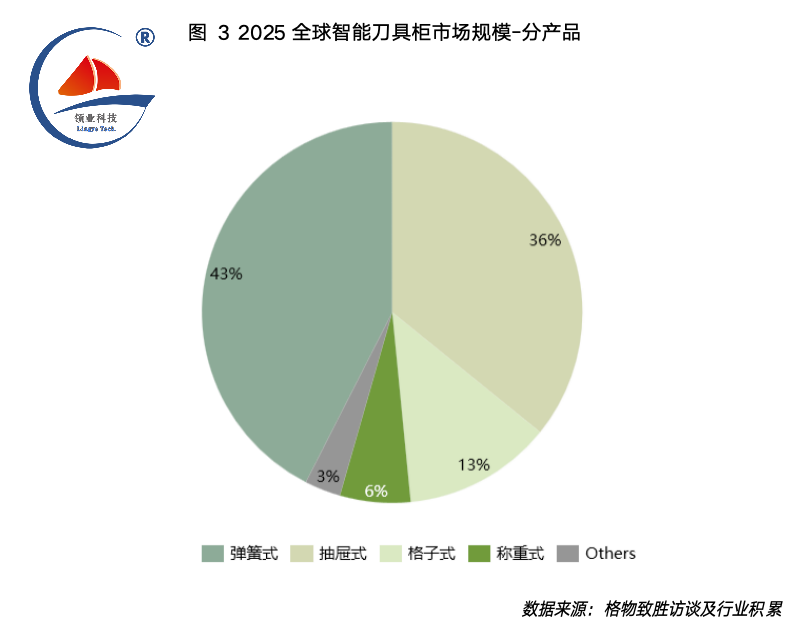
2025, the spring type structure will still be the mainstream form of intelligent tool cabinets, with a market share of about 43%; Drawer style is closely followed, accounting for about 36%; The proportion of grid pattern is 13%; However, the proportion of applications of weighing methods is relatively low, about 6%, due to factors such as scene adaptability.
The main advantages of the spring type intelligent tool cabinet are fast access and high-density storage. The spring structure design can achieve automatic tool ejection and reset, suitable for high-frequency retrieval scenarios, reducing operation time. In continuous production lines, the spring type tool cabinet can be linked with the robotic arm to improve processing efficiency.
The drawer style intelligent tool cabinet supports the classification and storage of different types of tools through adjustable tool cover plates and layered drawer designs, which can meet the needs of multiple scenarios. In high-end fields such as automotive manufacturing and aerospace, drawer style tool cabinets are the core equipment of intelligent factories, supporting the full life cycle management of tools in unmanned workshops.
The grid type intelligent cabinet adopts a multi grid layered design, with each grid independently encoded for quick positioning and traceability. It is particularly suitable for multi variety and small batch production modes, and supports modular expansion. The number and size of grids can be flexibly adjusted according to production needs to adapt to different production material specifications.
The weighing intelligent cabinet monitors the usage of production materials in real time through built-in weighing sensors, and combines algorithms to predict inventory demand, reduce stockouts or redundancies, and achieve precise inventory management. It is suitable for high-value production material management and is widely used in the semiconductor and medical device manufacturing fields.
Looking ahead to the future, each segmented product will rely on its core advantages to achieve deep vertical penetration into corresponding scenarios, and the market growth pattern will show a differentiated evolution trend: the spring type, with its high-speed picking and releasing efficiency advantage in automated production lines, is expected to become the core engine driving overall market growth, leading the industry growth rate; Drawer style, relying on high integration technology, meets the continuous upgrading needs of high-end manufacturing scenarios, and its market share in the high-end application field will further expand; The grid pattern has enormous growth potential in small and medium-sized enterprises and emerging markets due to its adaptability to flexible and varied production modes; Weighing based inventory management enables precise inventory control through data empowerment, accurately matching the management needs of valuable and precision consumables in fields such as aerospace, precision molds, healthcare, and new energy vehicles. It is expected to usher in a period of rapid growth.
1.5 Regional distribution of global intelligent tool cabinets
From the perspective of the incremental pattern of the global intelligent tool cabinet market in 2025, the regional distribution characteristics show a significant bipolar dominance and echelon supplementation trend. China is on par with Europe and America, accounting for a total of 72% of the global increment and occupying an absolute dominant position in the market; The Japanese and Korean markets maintain a stable market share of 15%; Emerging regions such as the Middle East and Southeast Asia are building new growth curves with a 13% share.
The European and American regions, with their profound manufacturing industry accumulation, occupy a global dominant position in high-end capital intensive industries such as automobiles, aerospace, and precision machinery. This type of scenario imposes extremely strict requirements on the accuracy maintenance, life matching, and management efficiency of the entire lifecycle of cutting tools. As the core terminal of flexible manufacturing systems, intelligent tool cabinets perfectly adapt to their efficient and continuous production demands. In addition, due to structural constraints of high labor costs, European and American manufacturing enterprises have long faced pressure to reduce costs and increase efficiency. Intelligent tool cabinets replace manual intervention and achieve digital inventory control, effectively reducing management losses and improving overall equipment efficiency, becoming a standard for enterprise digital transformation and supporting regional demand to maintain high-level operation.
As the world's largest manufacturing country, China has a full industry chain ecosystem covering automobiles, electronics, and mechanical processing, nurturing the world's largest tool consumption market. At present, the manufacturing industry is in a critical cycle of transitioning from "scale" to "intelligence", and there is a significant upgrade in the endogenous demand for digital tool management from leading enterprises and waist manufacturers. At the policy level, the continuous empowerment of the national intelligent manufacturing strategy has lowered the threshold for equipment landing; At the industrial level, local suppliers rely on high cost-effectiveness and agile localized services to effectively penetrate the procurement decision-making chain of small and medium-sized manufacturers. These factors collectively drive the accelerated increase in penetration rate of intelligent tool cabinets, forming a core source of global growth increment.
The manufacturing industry in Japan and South Korea presents distinct characteristics of high precision and strong automation, mastering core processes in fields such as automobiles, semiconductors, and high-end machine tools. Enterprises have an ultimate pursuit of micrometer level precision and millisecond level efficiency in the production process. Intelligent tool cabinets can be deeply integrated with automated production lines and advanced production management systems to achieve precise matching and rapid replacement of tools.Relying on the dividends of global industrial chain reconstruction, Southeast Asia's manufacturing industry is in a period of rapid expansion, with significant cluster effects in industries such as electronics, equipment, and auto parts.
With the expansion of industrial scale, enterprises are shifting from simply pursuing low cost to high efficiency, and the demand for visualization and intelligence in tool management is beginning to emerge. Although the current labor cost advantage still exists, the upward trend of land, operation, and hidden costs has gradually emerged. Faced with cost pressure, enterprises need to improve unit efficiency through intelligent equipment. Intelligent tool cabinets, as a key solution to cope with cost increases, have a low base and high growth market penetration rate, and are expected to become an indispensable growth pole in the global market in the future.
1.6 Global pattern of intelligent tool cabinet manufacturers
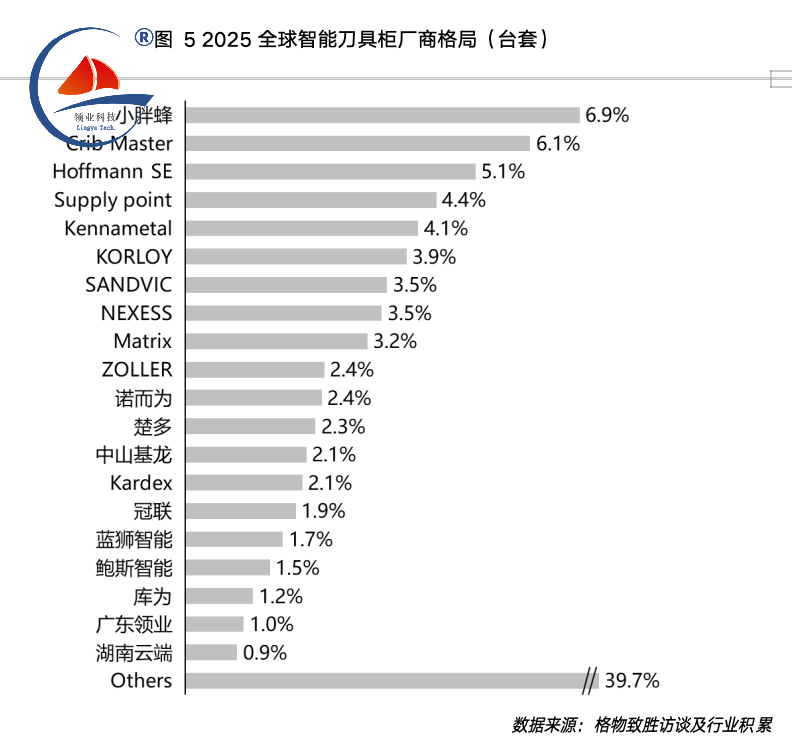
In 2025, the global intelligent tool cabinet market will exhibit typical "fragmented competition" characteristics, with industry concentration at a relatively low level and competition becoming increasingly fierce. The market concentration of TOP10 manufacturers is only 43.2%, while the market concentration of TOP20 manufacturers is 60.3%, which means that nearly 40% of the market share is still dispersed among many small and medium-sized players. The lower technological and financial barriers have lowered the market entry threshold, resulting in a large number of market participants and obvious differentiation of tiers. New entrants continue to enter, making the market in a high competition, low monopoly red sea stage.
The global market is showing a significant trend of "bipolar differentiation", with European and American manufacturers occupying the high-end track, while Chinese manufacturers are rapidly breaking through in the mid to low end track. Relying on their profound industrial technology accumulation, European and American manufacturers have core advantages in product integration, software and hardware compatibility, and system stability. Their products are deeply adapted to high-end precision manufacturing scenarios such as aerospace and medical, and with long-term established brand reputation and technological barriers, they occupy a high value-added market share. Among them, Crib Master and Hoffmann SE have become benchmark top players in the global high-end field with their ultimate stability and precise control capabilities in product performance.
1.7 Global Smart Tool Cabinet Brand Landscape
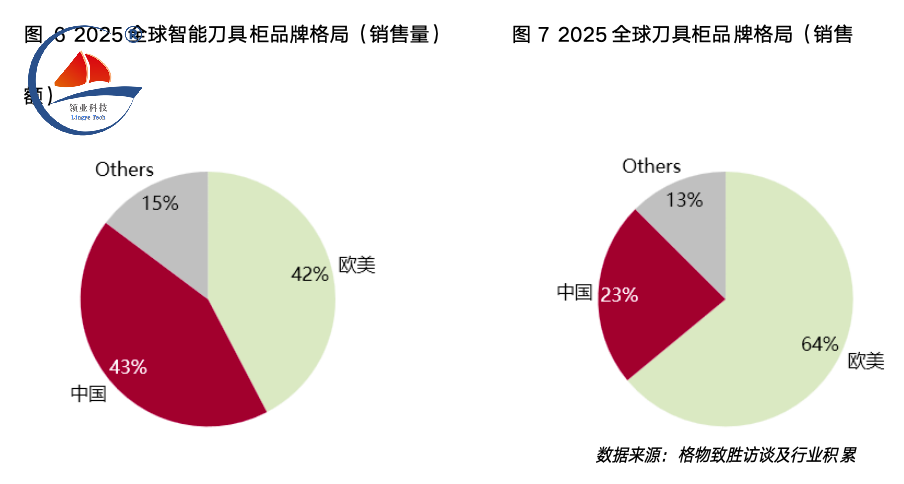
From the perspective of sales volume, the global market presents a pattern of dual dominance between China and the United States. The sales share of European and American manufacturers and Chinese manufacturers is about 42% and 43% respectively, and the two are evenly matched in terms of market coverage. However, from the perspective of sales revenue, the market pattern shows a significant phenomenon of value inversion. Driven by differences in product structure and application scenarios, Chinese manufacturers' main products are concentrated in the mid to low end market, with relatively low average prices; And European and American brands are deeply bound to precision manufacturing scenarios such as aerospace and high-end automobiles, with strong product premium capabilities. This structural difference has led European and American manufacturers to leverage 64% of market sales with a sales share of 42%; On the other hand, Chinese manufacturers, despite leading in sales, only maintain a sales proportion of around 23%.
It is expected that in the future, as Chinese manufacturers continue to break through technological barriers and upgrade their product capabilities, intelligent tool cabinets will gradually penetrate from mid to low-end to high-end scenarios. With the value shift of product structure, Chinese manufacturers will experience a dual increase in their global market share: on the one hand, their sales share will continue to expand based on their cost-effectiveness advantages; On the other hand, the proportion of sales revenue will significantly converge with the enhancement of product premium ability, gradually narrowing the value gap with European and American manufacturers.Chapter 2: Growth Potential and Trend Analysis of Global Intelligent Tool Cabinets
2.1 Global Trends in Intelligent Tool Cabinet Technology Development
The future development of product technology for global intelligent tool cabinets will revolve around three core directions: intelligence, customization, and energy conservation and environmental protection. Technological iteration will further improve the management efficiency, scene adaptability, and green development level of products. The specific development trends are as follows:
Perception and recognition technology is the core foundation for intelligent tool cabinets to achieve automated management. Its development core is to improve recognition accuracy, expand adaptation range, accelerate response speed, and reduce application costs. Early intelligent tool cabinets mainly used barcode recognition technology. Although they have the advantages of low cost and flexible application, they have limitations such as easy contamination, limited information storage capacity, and the ability to recognize only a single label at a time. They can no longer meet the market demand for high-frequency tool changing and multi category tool management. Radio frequency identification (RFID) technology has gradually become the mainstream in the industry. Its advantages of pollution resistance, long reading distance, ability to recognize multiple tags simultaneously, and erasable information effectively solve the pain points of barcode recognition technology. Currently, perception and recognition technology is undergoing a new round of upgrades, with the core development direction being unlabeled and multimodal fusion. On the one hand, the deep integration of machine vision and AI algorithms is gradually replacing the traditional RFID labeling mode. Through image recognition technology, automatic identification and information registration of irregular and micro cutting tools can be achieved without the need for additional labeling, effectively solving the problems of high tag costs and difficult adaptation of irregular cutting tools in traditional RFID technology, further reducing the threshold for enterprise application; On the other hand, a multimodal perception system is gradually being constructed, which deeply integrates RFID recognition, weighing sensing, acoustic emission sensing, vibration sensing, temperature sensing, and can achieve real-time monitoring of key parameters such as tool in place status, wear degree, fracture abnormality, vibration amplitude, etc., providing accurate data support for tool life prediction and production safety warning, and realizing the transformation of tool management from "passive recording" to "active prediction".
Customization is the core development direction for intelligent tool cabinets to adapt to the production needs of different industries and enterprises of different scales. Manufacturers will design personalized products based on customers' production processes, spatial layout, and management requirements, achieving a high degree of matching between products and application scenarios. For example, automobile manufacturing enterprises have a large production scale, frequent use of cutting tools, and a wide variety of categories. They have high requirements for the large capacity and high automation of tool cabinets, and need to be closely integrated with production lines; Small mechanical processing enterprises pay more attention to the economy and practicality of their products, and only require the tool cabinet to have basic management functions such as borrowing, returning, and tracing. At the same time, customized design will be extended to optimize special application environments, such as adding dust-proof and waterproof sealing designs to tool cabinets for industrial environments with high dust and humidity, protecting the service life of tools and internal electronic components, and improving the environmental adaptability of products.
Against the backdrop of the global goal of carbon neutrality, energy conservation and environmental protection have become important directions for the development of intelligent tool cabinet technology. Manufacturers will improve the green development level of their products and enhance their global market competitiveness through technological innovation, raw material innovation, and service extension. In terms of operational energy conservation, they will dynamically adjust the operating mode of tool cabinets through IoT sensors and big data analysis technology to reduce ineffective energy consumption; Integrating energy-saving technologies such as LED lighting and intelligent sensing switches, some manufacturers have begun to adopt solar powered or energy storage systems to further reduce product energy consumption; In terms of raw materials, environmentally friendly materials such as recyclable metals and biobased composite materials are used to reduce environmental pollution during product production and disposal processes; In terms of extending the industrial chain, some manufacturers have launched tool recycling and refurbishment services to extend the product lifecycle of tools and tool cabinets, achieving resource recycling.
2.2 Global Intelligent Tool Cabinet Growth Potential and Trend Analysis
The global smart tool cabinet market is expected to maintain a compound growth rate of over 10% from 2026 to 2030. At the national policy level, it is mainly driven by the upgrading of manufacturing automation, the promotion of Industry 4.0, and emerging market demand. Developed countries such as the European Union, the United States, and Japan have also introduced Industry 4.0 related policies to promote the popularization of smart tool cabinets in high-end manufacturing. The EU's green manufacturing regulations also promote the development of smart tool cabinets towards energy conservation and environmental protection, further expanding product application scenarios. At the local policy level, local governments have included intelligent tool management equipment in the subsidy catalog for intelligent manufacturing equipment, reducing procurement costs for enterprises through financial subsidies, tax deductions, and other means.
The intelligent tool cabinet effectively solves the pain points of traditional management through intelligent technology, achieves precision and efficiency in tool management, and provides important support for enterprises to reduce costs and improve efficiency. From the perspective of cost control, the average price of an intelligent tool cabinet is about 20000 to 50000 yuan. Small businesses can choose the basic model to reduce initial investment, and the average annual savings in labor costs (reducing 1-2 administrators), loss costs (reducing 3% -8%), and inventory costs (reducing 20% -30% backlog) can reach 100000 to 200000 yuan. The investment payback period is usually less than one year, and the cost-effectiveness advantage is significant. From the perspective of efficiency improvement, the intelligent tool cabinet achieves fast tool access through functions such as RFID automatic recognition and touch screen operation, reducing the retrieval time from tens of minutes in traditional mode to less than 30 seconds, and improving inventory counting efficiency by more than 80% compared to traditional mode. At the same time, the intelligent tool cabinet can achieve full traceability of tool usage, avoid tool misuse, and improve product processing accuracy.
With the transformation and upgrading of the manufacturing industry towards intelligence and automation in the Chinese market, enterprises have become increasingly strict in managing their production processes. As a key equipment for achieving intelligent tool management, intelligent tool cabinets can improve production efficiency, reduce costs, and ensure product quality. With the continuous increase of national policies, the demand for intelligent tool cabinets is rapidly growing. At present, due to cost constraints, the coverage of smart tool cabinets in small and medium-sized enterprises is relatively low. In the future, with the support of national tax incentives and other subsidy policies, as well as the continuous improvement of technology and product optimization by smart tool cabinet manufacturers, and the increase in market participants, the price of smart tool cabinets will further decrease, which will stimulate the continuous growth of demand for smart tool cabinets in small and medium-sized enterprises.
Driven by the triple drive of manufacturing upgrading, policy dividends, and technological penetration, the demand for intelligent tool cabinets in the Southeast Asian market shows strong growth potential and has become an emerging growth pole in the global market. The trend of global manufacturing shifting to Southeast Asia continues, with rapid expansion of industries such as automotive electronics and semiconductor manufacturing in Vietnam, Thailand, Malaysia, and other countries, driving market demand for intelligent tool cabinets. For smart tool cabinet manufacturers, the core of their layout in the Southeast Asian market is to provide customized solutions: on the one hand, they focus on rapidly expanding fields such as automotive electronics and semiconductor manufacturing, and develop products that are suitable for regional industrial characteristics; On the other hand, developing scalable intelligent tool cabinet products, supporting subsequent functional upgrades, adapting to the needs of enterprises' phased digital transformation, and quickly seizing market share through localized operations and product customization.
Chapter 3: Introduction to Typical Manufacturers
3.1 Smart Bee
Company Name: Shenzhen Danfu Technology Co., Ltd
Country: China
Established in 2015
Company Profile: Shenzhen Danfu Technology Co., Ltd. was established in 2015. It is a technology-based enterprise specializing in digital solutions for the mechanical processing industry. With more than ten years of deep cultivation in the field of mechanical processing, the company's brand vision is "empowering manufacturing with digital intelligence, making the world have no difficult factories to manage", helping machining enterprises achieve digital and intelligent transformation of the entire production, management, and warehousing process, breaking through information silos in various production links, and promoting high-quality development of the industry.
Main business: Smart Bee Intelligent Tool Cabinet, Tool Cabinet, Weighing Cabinet, Digital Warehouse, Smart Bee AI Work Order Treasure, Smart Bee Machine Plus Cloud, covering core scenarios such as production management, warehouse control, and work order collaboration for machining enterprises in all aspects, achieving comprehensive digital control of "human-machine material, legal environment".
3.2 Crib Master
Company Name: CribMaster Inc
Country: United States
Established in 1992
Company Profile: CribMaster is a leading global provider of intelligent warehousing and automated tool management solutions, headquartered in the United States and a subsidiary of Stanley Black&Decker. The company focuses on optimizing the management efficiency of tools, cutting tools, and consumables in the industrial field through technological innovation, helping customers achieve precise inventory control and production process automation upgrades. Currently, it has provided services to more than 12000 customers in 36 countries/regions.
Main Business: Intelligent Tool and Consumables Management, Industrial Vending Solutions, Software Driven Inventory Management Platform, and Industry Customized Services
3.3 Hoffmann SE
Company Name: Hoffmann Group
Country: Germany
Established in 1919
Company Profile: Hoffmann SE was founded in 1919, initially focusing on the sales of welding equipment and automotive parts, and gradually expanding into the field of industrial tools. In 1993, Hoffmann Group was officially established, integrating multiple partners and becoming a leader in the German market. In 2003, the company established its English name "Hoffmann Group" and covered more than 50 countries, including China, Southeast Asia, Europe, etc., through its global branch offices and partner network. The company focuses on high-end tool brands GARANT and HOLEX, providing cutting tools, fixtures, measuring tools and other products widely used in automotive manufacturing, aerospace and other fields. In 2022, Swiss SFS Group merged with Hoffmann SE to further strengthen its international competitiveness, expand its product line and service scope.
Main business: Tool supply chain management, intelligent warehousing solutions, one-stop procurement of industrial consumables
3.4 Kennametal
Company Name: Kennametal Inc
Country: United States
Established in 1938
Company Profile: Kennametal was founded in 1938 and is headquartered in Latrobe, Pennsylvania, USA. It is a leading global enterprise in the field of metal cutting tools and materials science. The company's business covers more than 60 countries, with over 14000 employees and annual sales exceeding 2.5 billion US dollars. About 45% of its revenue comes from new products launched in the past five years. Kennametal is not only a tool manufacturer, but also a comprehensive service provider providing metal processing solutions. Its products are widely used in fields such as automotive, aerospace, energy, mining, construction, and general machinery processing.
Main business: Kennametal's product line covers the entire process of tool systems such as cutting, milling, turning, drilling, and threading, including turning tools, milling tools, drilling tools, and intelligent tool management systems.
3.5 Supply Point
Company Name: Supply Point Inc
Country: United Kingdom
Established in 1998
Company Profile: Supply Point is a leading global provider of intelligent inventory management solutions, focusing on optimizing tool and consumables management in industrial, medical, and other fields through the Internet of Things (IoT) and automation technology. It has branches in North America, Europe, and Asia, serving over 50 countries. SupplyPoint has two research and development centers and production bases in the UK and the US, as well as branch offices in Germany, Italy, China, India, and Brazil. Additionally, it has numerous professional distributors in over 30 countries and regions worldwide.
Main business: intelligent tool management, medical and laboratory storage, software platform integration.